What to Ask For Before the Temporary Fence Panels Arrive
A few questions before delivery day save real time and headaches once the job is underway.
September 4, 2026 · 3 min read
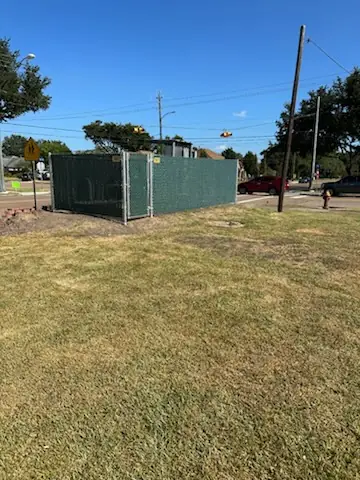
Temporary fencing looks simple from the outside, panels go up, the site is enclosed, done. What actually determines whether it works for the length of a project is a handful of details that are much easier to get right before delivery than to fix after the crew has already started moving equipment around it.
Measure the actual perimeter, not the lot line
Panel count should come from walking the real perimeter that needs to be enclosed, not the property line on a plat. Corners eat more panels than people expect, since each turn needs its own base and bracing rather than a panel simply bending to follow the angle. If the site has an irregular footprint, staging area, or a section that needs to stay open for deliveries partway through the job, it's worth mapping that out before panels are ordered rather than working around a fixed count once they've arrived.
Windscreen is doing more than blocking dust
Green privacy windscreen is standard on most job sites for keeping debris contained and the site out of view from the street, and most owners want it for exactly that reason. What people underestimate is what it does to wind load on the fence itself. A bare chain link panel lets wind pass through it. A panel wrapped in windscreen catches wind the way a sail does, which means the base weights and bracing need to be sized for that from the start, not added after the first storm knocks a section flat. This is one of the details worth confirming directly rather than assuming the standard package covers it.
Gate width should match what's actually coming through
A single walk gate is fine for foot traffic and hand tools. It is not fine for a skid steer or a delivery truck. Knowing what equipment needs site access, and when during the project timeline, determines whether you need a double drive gate from day one or can add one later. Getting this wrong usually means either paying for access that never gets used, or discovering mid-project that the excavator can't get through the gate that's already installed.
Know the timeline before the panels get delivered
Project schedules move, and a fence that goes up for what's planned as a six-week foundation phase sometimes needs to stay through the whole build once phases run long. Confirming the expected duration up front, and how easily that can be extended if the schedule slips, saves a scramble later. It also matters for placement: a perimeter set for the foundation and framing stage doesn't always make sense once exterior work starts and different parts of the site need access. Walking the phased site plan with whoever is supplying the fence, rather than just the current-week footprint, usually means fewer panels have to be moved partway through the job.
Settle who's responsible for what before day one
A construction site is an active environment, and panels get bumped by equipment, knocked by wind, or shifted by material deliveries over the course of a job. It's worth being clear up front about who resets a panel that's been knocked out of line during working hours, and who to call if something's damaged or a gate isn't latching securely before the crew leaves for the evening. A perimeter that's meant to keep a site secure only does that job if it actually gets maintained through the length of the project, not just on the day it went up.
We supply and install temporary chain link fencing, secure gate access, and perimeter control for job sites across Pasadena, Deer Park, La Porte, South Houston, and Pearland, and we're glad to walk a site with you before delivery day to work out panel count, gate placement, and windscreen needs. Free, no-obligation on-site estimates, same as everything else we do.
Pasadena Fence Co. — (281) 998-9190
Call (281) 998-9190More articles
Why Fences Lean on Pasadena's Clay (and What Actually Stops It)
The reason a five-year-old fence starts leaning here almost never has to do with the wood. It has to do with what's under it.
Cedar Privacy, Chain Link, or Ornamental Iron: How to Actually Choose
The right fence for your yard depends on what you're trying to solve, not on which one is cheapest to put up.